
.png?width=563&height=144&name=New%20GF%20Logo%20(37).png "New GF Logo (37)")



Most business owners receive an income statement and balance sheet each month. These basic financial statements are essential, but they may not provide enough detail to answer every question leaders have about pricing, profitability, cash flow, and operational performance.
Management reporting builds on that financial foundation. It organizes and analyzes the same underlying data to show what is driving results and where leadership may need to act.
The two are not separate or competing forms of reporting. They represent different points along the same reporting continuum, moving from accurate financial statements to deeper analysis, forecasting, and decision support.
Key Article Takeaways
- Basic financial statements show overall profitability, financial position, and cash movement.
- Management reporting adds detail by department, customer, service, location, job, or another meaningful segment.
- Reliable management reports depend on accurate books and timely financial statements.
- The best reports are tied to specific business goals and decisions.
What Should Your Financial Reporting Help You Answer?
Business owners and executives need information that answers questions such as:
- Am I pricing my services or jobs correctly?
- Did the company generate more profit this quarter than last quarter?
- Which customers, services, or locations are most profitable?
- Do we have enough cash to make payroll and cover upcoming expenses?
- Are we operating within budget?
- Which teams are most productive?
- Which investments are generating a return?
- What is likely to happen to cash over the next several weeks?
Basic financial statements answer some of these questions. Management reporting provides the additional detail needed to answer the rest.
The Financial Reporting Continuum
A strong reporting process typically develops through four stages:
- Accurate books: Transactions are recorded consistently, accounts are reconciled, and the books are closed on time.
- Basic financial statements: Leadership receives regular income statements, balance sheets, and statements of cash flows.
- Enhanced financial insights: Results are analyzed by department, customer, location, service, job, or another business driver.
- Forecasting and decision support: Historical results and current trends are used to create budgets, forecasts, and financial scenarios.
Each stage depends on the one before it. A cash flow forecast, profitability analysis, or KPI dashboard will only be useful when it is built on reliable financial data.
What Are Basic Financial Statements?
Basic financial statements provide a company-wide view of financial performance and position.
Income Statement
Also called a profit and loss statement, the income statement shows revenue, expenses, and profit or loss over a specific period.
It helps leaders understand whether the business is profitable, how expenses are changing, and how current performance compares with previous periods.
Balance Sheet
The balance sheet shows what the company owns, what it owes, and the owner’s or shareholders’ equity at a specific point in time.
It provides insight into assets, liabilities, debt, working capital, and the overall financial position of the business.
Statement of Cash Flows
The statement of cash flows explains how cash moved through operating, investing, and financing activities.
This report can help explain why a profitable business is still experiencing cash constraints. Profit and cash are connected, but they are not the same.
Depending on the business and its reporting requirements, a complete set of financial statements may also include a statement of equity and accompanying notes. Accounts payable, accounts receivable, and other supporting schedules provide additional detail behind the statements.
The SEC’s guide to financial statements provides a helpful overview of how the primary statements work together.
Financial statements may be shared with lenders, investors, tax professionals, board members, and other stakeholders. They are also valuable internally because they help leadership monitor financial health and identify significant changes.
However, company-wide totals do not always explain why those changes occurred.
What Is Management Reporting?
Management reporting uses financial and operational data to examine specific areas of the business.
Instead of only showing that revenue or profit changed, management reports help identify the customers, services, departments, jobs, or operating decisions that contributed to that result.
Common management reports and metrics include:
- Profit and loss by department, location, team, job, or service line
- Gross margin and contribution margin
- Budget versus actual results
- Cash flow forecasts
- Trailing 12-month trends
- Customer profitability
- Accounts receivable aging
- Customer acquisition cost
- Customer lifetime value
- Utilization and realization rates
- Return on labor
- Revenue and profit per employee
- Employee retention and attrition
- KPI dashboards
Management reports are primarily designed for internal use, so they can be customized around the company’s business model, operating structure, and goals.
How Management Reporting Adds Context
Suppose an income statement shows that revenue increased while profit declined.
The income statement identifies the issue. Management reporting helps explain it.
Additional analysis might reveal that:
- One service line generated higher revenue but lower margins.
- A large customer required more labor than expected.
- Overtime increased in one department.
- Discounts reduced profitability.
- Customer acquisition costs increased.
- A new program did not generate the expected return.
With that information, leadership can consider specific actions, such as adjusting prices, changing staffing levels, renegotiating a contract, revising a marketing strategy, or discontinuing an unprofitable service.
Basic Financial Statements and Management Reporting
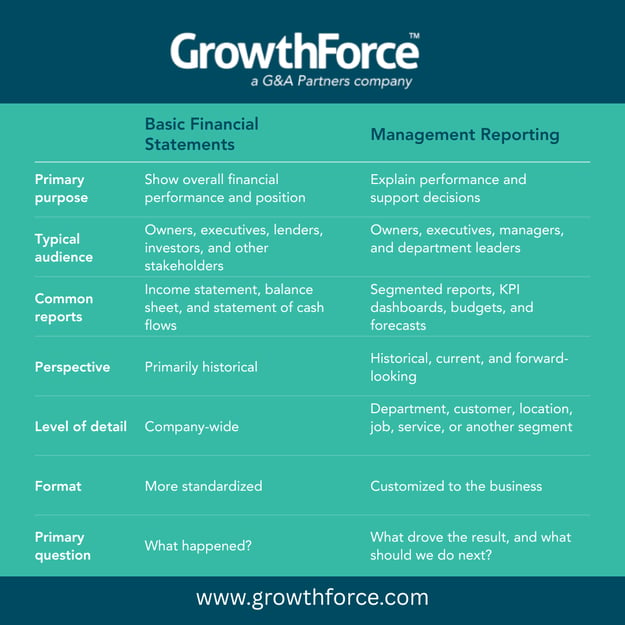
Choosing the Right Management Reports
Businesses can track thousands of metrics, but more reporting does not automatically lead to better decisions.
The most common mistake is producing reports that leadership does not review or use. Effective management reporting starts with a business objective, not a list of available KPIs.
Ask:
- What are we trying to improve?
- What decision does leadership need to make?
- Which factors influence that outcome?
- How will we measure progress?
- Who will review the information and take action?
What Should a Monthly Reporting Package Include?
The right package will vary, but many businesses benefit from reviewing:
- Income statement
- Balance sheet
- Statement of cash flows
- Accounts receivable and accounts payable summaries
- Budget versus actual results
- Cash flow forecast
- Trailing 12-month trends
- Five to eight KPIs tied to current goals
- Segmented profitability reports
- Written observations, risks, and recommended actions
The monthly review should go beyond presenting numbers. Leadership should identify significant changes, investigate what caused them, decide whether action is needed, and assign responsibility for the next step.
Download: The One Page Scorecard Guide
Read More: How Much Do Outsourced CFO Services Cost?
Get the Financial Insights You Need With GrowthForce
GrowthForce provides outsourced bookkeeping, accounting, controller, and management reporting support for growing businesses and nonprofit organizations.
We help leadership teams maintain accurate books, complete the month-end close, and develop reporting packages around their goals and decision-making needs.
Depending on the organization, that package may include core financial statements, segmented profitability reports, KPI dashboards, budget comparisons, cash flow forecasts, and other enhanced financial insights.
The result is reporting that helps leadership understand performance, identify opportunities, and make informed decisions about what comes next.

This content is for informational purposes only and should not be considered financial, legal, or tax advice. Contact us to speak with a qualified professional for guidance tailored to your needs.